
All Posts By

IWCF

The International Well Control Forum (IWCF) Syllabus Framework

By Blog

This edition of our blog series outlines how learning objectives, outcomes, and importance levels work together to create a clear and consistent framework for teaching and learning.


A well-structured syllabus is fundamental to any educational programme. It provides clear learning objectives and specific outcomes and ensures a level of standardisation between training institutions and teachers/instructors.  

For well control training, having the correct skills and knowledge makes the difference between a controlled situation and a catastrophic blowout. This is why the syllabus is intentionally designed and structured to ensure all key topics are adequately taught and assessed. 

What is a learning objective?

A learning objective is a clear, general statement that outlines the topic which will be taught and assessed.  It sets the context for the more detailed and specific learning outcome. 

What is a learning outcome?

Learning outcomes are detailed and make the results of learning clear, specific, and measurable. Action verbs such as ‘identify’, ‘explain’ or ‘describe’ signal to the instructor the scope the candidate must have to effectively meet the syllabus requirement. 

Importance levels 

The IWCF Drilling Well Control and the Well Intervention Pressure Control syllabi both apply importance level weightings to topics.  

This framework highlights the most safety-critical principles, ensuring candidates build the core competencies needed to understand the full syllabus and develop the skills they will need in their roles.  

Below is an example of the importance level structure from the WIPC syllabus. 
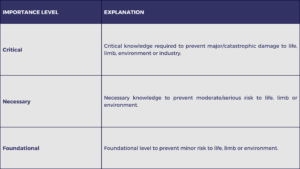
  

Syllabus categories marked with higher importance levels often contain principles that, while introduced within a specific section, are not confined to a single learning outcome.  

These topics are critical for safe and effective operations that may appear throughout the entire well control syllabus, appearing in multiple contexts. Assessment questions often incorporate these principles when asking candidates to identify the safest or most appropriate first action in response to a well control scenario. 

Examples of high-importance topics include managing barriers, leak detection, kick warning signs and indicators, secondary well control, and the management of non-shearables across the BOP. 

IWCF has designed the syllabus in a way that all topics are necessary and must be both taught and assessed. While Level A outcomes represent the most safety-critical knowledge and skills, Levels B and C remain essential for supporting safe and effective operations.

Why this matters

Aligning learning objectives, outcomes, and importance levels gives both instructors and candidates a clear understanding of what’s expected and how each topic fits within the wider framework. 

The IWCF syllabus framework ensures that every essential topic is taught and assessed consistently, supporting our goal of maintaining the highest standards of well control training worldwide.


If you have any questions about our syllabi for IWCF programmes, please contact us at assessmentdevelopment@iwcf.org. 

The Role of Continuous Review in Assessment Quality

By Blog

As a global certification body, IWCF delivers high-stakes, summative assessments that are trusted worldwide to measure the skills and knowledge of safety-critical personnel.

Given the critical role our assessments play, we are committed to ensuring that every question remains consistent, technically robust, and fair to all candidates. Our technical review process is a key component of our overall approach to maintaining assessment quality.

What Is the Technical Review Process? 

Before a question is included in an assessment, it undergoes a technical and quality review. This process confirms technical accuracy, clarity, and alignment with established standards.

Once questions are active, we monitor their performance through an ongoing review process. This helps maintain the validity, relevance, and fairness of assessments over time, and across languages and regions.

Our review process involves four core activities: 

  1. Monitoring Candidate Feedback
    Candidates are encouraged to provide feedback on individual questions following their assessments. Feedback can address any aspect of a question, including its technical content, wording, or answer options.All candidate feedback is reviewed by a team member. We analyse both individual comments and broader patterns to determine whether multiple candidates are raising similar concerns, whether the feedback comes from specific regions or languages, or whether technical or wording issues are being identified.We recognise that feedback reflects a wide range of perspectives and experiences across our candidate base. While we cannot respond to every comment individually, we carefully consider each one.
  2. Analysing Data
    Robust reporting tools enable us to monitor question performance across languages and regions. This helps us to identify whether questions are performing consistently or if variations exist in specific languages or locations.We also examine how often candidates select each answer option, providing insight into question clarity and difficulty.
  3. Technical Review by Subject Matter Experts (SMEs)
    Data gathered from candidate feedback and pass rate analysis is reviewed by a panel of subject matter experts from diverse regions and backgrounds. They use this data, along with candidate feedback, to evaluate whether a question requires updates.The panel aims to avoid unnecessary or subjective changes. In some cases, the best course of action is to maintain the current version of the question. In others, wording or technical terminology may be updated to improve clarity or reflect industry developments.
  4. Continuous Monitoring over time
    Whether amendments are made or not, our monitoring continues. We consistently review feedback and performance data to identify trends or patterns that may signal the need for further review. When questions are repeatedly flagged in feedback but confirmed as technically sound through review, we highlight these in the Instructor Focus section of our Instructor and Assessor Newsletter. This provides valuable insight into common candidate misunderstandings and supports targeted instruction. 


Why Does This Matter?
 

We take the quality and relevance of our assessment questions seriously. Continuous review is not just a process, it is fundamental to our mission of reducing risk to life, assets and environment caused by well control incidents.

The technical review process supports: 

  • Fairness: Every candidate, regardless of location or language, deserves an equal opportunity to succeed. By reviewing pass rates and feedback across regions, we help ensure consistent standards for all. 
  • Continuous Improvement: Assessments must evolve over time. Regular review allows us to refine content in line with changes in industry standards and candidate needs. 
  • Trust: Organisations and individuals rely on the validity of our certifications. Our review process demonstrates our commitment to maintaining high-quality standards.

Summary 

Our technical review process plays a central role in ensuring IWCF certification remains fair, valid, and fit for purpose. 

By analysing candidate feedback and pass rate data, we identify trends, address potential issues, and make informed improvements to our assessment.

If you have any specific feedback you’d like us to consider, please contact us at assessmentdevelopment@iwcf.org.

International Well Control Forum (IWCF) Opens Registration for 2025 Well Control Workshop and AGM in Istanbul

By News

The International Well Control Forum (IWCF) invites its members to register for the Well Control Workshop and Annual General Meeting (AGM) 2025, taking place at the Fairmont Quasar Istanbul, Turkey, on Wednesday 19 – Thursday 20 November 2025. 

Following the success of the 2024 event held at Hilton The Hague in the Netherlands, the 2025 edition presents another valuable opportunity for industry professionals to connect, explore well control developments, and contribute to the future direction of the industry. 

“The event in The Hague was very informative and extremely well-organised. It was a fantastic opportunity to network and exchange ideas with others in the field.”
2024 Delegate Feedback 

The Workshop and AGM support IWCF’s mission to define, deliver and maintain the highest possible standards in well control training, accreditation and certification. The event aligns with IWCF’s vision of no risk to life, assets or the natural environment through well control incidents. 

IWCF members are invited to attend free of charge, with ticket options available for: 

  • In-person attendance at the Workshop and AGM at the Fairmont Quasar Istanbul on 19–20 November. 
  • Virtual attendance at the AGM via Microsoft Teams on Thursday 20 November. 

Members may choose to attend the AGM either in person or virtually. Opportunities are also available for member organisations to exhibit and submit presentation topics for consideration. 

 “This event continues to serve as a platform for global collaboration, knowledge exchange and technical development in the well control sector,”
said Zdenek Sehnal, IWCF CEO. 

Further details and registration information are available at:
www.iwcf.org/well-control-workshop-and-annual-general-meeting-2025 

Individuals who are not currently members and wish to attend can contact membership@iwcf.org for details on joining IWCF and securing a place at the event.

THE IMPORTANCE OF ASSESSMENT INTEGRITY IN A DIGITAL ENVIRONMENT

By Blog

Maintaining assessment integrity in a digital format presents considerable challenges. 

This article shares how we have adapted IWCF processes to ensure the assessment process remains valid, reliable and fair in an online environment.


Our recent newsletter highlighted a core value that underpins our work: our unwavering commitment to maintaining the highest standards of integrity. This commitment is critical as we adapt and strengthen our assessment processes in an increasingly digital world.  

The COVID-19 pandemic accelerated the transition from paper-based to digital formats. Post- pandemic, many institutions, including IWCF, have embraced online training and assessment due to its flexibility and accessibility.  

With this shift comes a significant concern: assessment security. Assessment and awarding bodies now need to consider new types of misconduct and negative behaviours that may not have previously been considered. 

Safeguarding high-stakes, summative assessment  

Assessment can generally be categorised into two types.  

Formative assessment is carried out by the instructor, throughout the learning process.  It is often low-stakes (informal, no serious outcomes) and can include quizzes, classroom discussions, exercises and other activities designed to check understanding and provide feedback. 

Summative Assessment is often high-stakes, as the outcome determines whether someone is qualified or competent for a role. Created by the assessment/awarding body, it evaluates whether a candidate has achieved the required standard of knowledge and competence.  

IWCF delivers high-stakes, summative assessment. Negative online behaviours such as cheating and dishonestly can have catastrophic consequences for the safety our industry. It is critical that our assessments must remain trusted and effective, ensuring those certified are skilled, competent and capable of managing the risks involved with well control operations.  

No single tool or feature can fully safeguard the assessment. That is why we apply multiple layers to create a robust authentication and security framework.  

Virtual invigilation  

Our invigilation partner, VICTVS, plays a key role in overseeing the assessment process. Invigilators (also called proctors) support candidates, monitor the test and help to prevent malpractice.  

  • ID checks: Invigilators verify each candidate’s ID to confirm they are the authorised test taker. 
  • Room checks: Candidates must use their webcam to do a 360-degree scan of their room before starting. This confirms they are alone and have no unauthorised materials. The invigilator also ensures the candidate’s video, sound, lighting, and workspace meet IWCF standards. 
  • Secure PINS: Candidates receive a one-time secure PIN to access their assessment. 
  • Multi-mode monitoring: Invigilators monitor candidates from multiple angles during their assessment. This includes a mobile device behind them, a webcam on their assessment device and live screen sharing. This approach reduces cheating and ensures candidates follow requirements throughout.  

Assessment Design  

The online framework also contributes to the security and integrity of the assessment process. 

  • Randomised question selection: sections of the assessment are randomised to ensure each candidate receives a unique sequence.  
  • Question banks: the system selects questions from a varied pool to ensure differences between candidates’ assessments. 
  • Answer order randomisation: Shuffling the answer choices encourages critical thinking and reduces cheating.  
  • Level-appropriate questions: Including scenario-based questions that reflect real-world well control challenges tests problem-solving and critical thinking rather than memory recall.  

Data monitoring  

A major advantage of online assessments is the wealth of data they generate. Unlike paper-based assessments, digital platforms provide instant insights into pass rates and performance trends across our global network of accredited training centres.  

Detecting integrity issues  

  • Unusual patterns such as sudden spikes in pass rates in certain regions could highlight compromised security.  
  • Technical issues: We can identify lags or connection problems and provide support.  
  • Global comparison: Analysing performance across regions helps us to ensure fairness in assessment conditions. 

Data monitoring also plays a significant role in ensuring the validity and reliability of our assessment questions. We will explore this further in a future post. 

Commitment to integrity  

With the right measures in place, assessment bodies can strengthen the overall assessment process, addressing concerns while providing a secure testing environment. 

IWCF will continue to be vigilant and adaptable as learning and assessment becomes increasingly digital and new challenges present themselves. 

We are grateful to our team, instructors and members who work daily to protect the integrity of IWCF assessments. We share a responsibility to ensure that our programmes remain not only effective, but fair and secure. 

Many of the points mentioned in this post are brief summaries of more in-depth, detailed IWCF procedures. If you have any questions related to our online assessment process, please contact information@iwcf.org. 

INTERNATIONAL WELL CONTROL FORUM (IWCF) LAUNCHES LEVEL 1 WELL CONTROL AWARENESS BOOK

By News

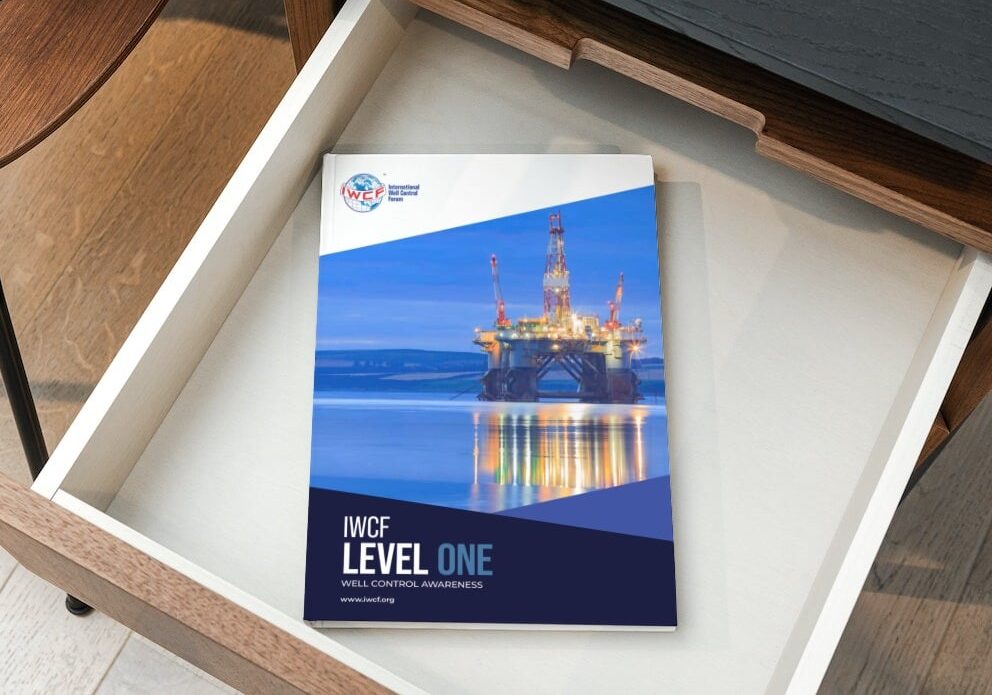
The International Well Control Forum (IWCF) has announced the launch of its Level 1 Well Control Awareness book, now available for purchase on Amazon. This comprehensive guide shares insights from IWCF’s highly successful Level 1 programme.

With over 100,000 candidates worldwide completing the programme, this book supports IWCF’s drive to increase the understanding of how well control incidents can occur, their consequences and prevention methods. The Level 1 Well Control Awareness book caters to a wide audience, including students, graduates, newcomers, and seasoned professionals. Whether readers are looking to build foundational knowledge or seeking a reference for well control training, this book serves as a valuable resource.

“We are thrilled to make the Level 1 Well Control Awareness book accessible to a broader audience through Amazon,” said IWCF CEO, Zdenek Sehnal. “Our mission is to define, deliver and maintain the highest possible standards in well control training, accreditation and certification, and we believe this book will contribute significantly to achieving that objective.”

For those eager to expand their knowledge of well control awareness, the Level 1 Well Control Awareness book is now available for purchase on Amazon.

Purchase your copy here!

Have questions? Contact IWCF at iwcfinformation@iwcf.org and stay connected with IWCF’s social media platforms for the latest updates!

INTERNATIONAL WELL CONTROL FORUM (IWCF) EXPANDS GLOBAL REACH WITH NEW LANGUAGE OFFERINGS FOR LEVEL 1 WELL CONTROL AWARENESS COURSE

By News

International Well Control Forum (IWCF) has recently introduced Modern Standard Arabic and Brazilian Portuguese translations for their Level 1 Well Control Awareness Course. Offering this course in multiple languages allows more users the opportunity to take an IWCF course in their native language, aligning with their mission to improve competency globally.

Level 1 is the first free, online course of its kind in the industry, designed to increase understanding of how well control incidents can occur, their consequences, and prevention methods. This course is a valuable resource for anyone new or experienced in the industry, including students and graduates, personnel involved in well control, and those with a general interest in the topic.

The addition of Modern Standard Arabic and Brazilian Portuguese marks a significant achievement for IWCF in its commitment to serving its diverse global membership.

These new languages align with IWCF’s mission to define, deliver and maintain the highest possible standards in well control training, accreditation and certification and provide competency assurance and continuous development globally.

Introducing the new languages means that users can now engage with the course content in their preferred language, facilitating a more immersive and effective learning experience. With multiple language options, IWCF ensures that learners can easily navigate through the course, creating a user-friendly and inclusive learning environment.

To access the Level 1 programme in various languages, follow these steps:

  • Log in to your account, and you will be taken to the Employee Dashboard.
  • Navigate to the ‘eLearning’ section on the Employee Dashboard.
  • Click on the ‘Start’ button corresponding to the language you want to take the course in.

If you want more information about a particular module, you can:

  • Click on ‘More info.’
  • This will provide details about the module, including what it covers and an estimated completion time.

Both of the new language options officially launched on 8 May 2024. Interested users can find comprehensive details about how to register for the Level 1 course, including the new language functionalities, on IWCF’s official website.

For more information and updates, follow IWCF’s social media platforms. This ensures you are updated on the latest developments, news, and updates related to the Level 1 Well Control Awareness Course and its new language offering.

Follow now to stay informed and stay ahead!


INTERNATIONAL WELL CONTROL FORUM (IWCF) ANNOUNCES 2024 WELL CONTROL WORKSHOP AND ANNUAL GENERAL MEETING

By News

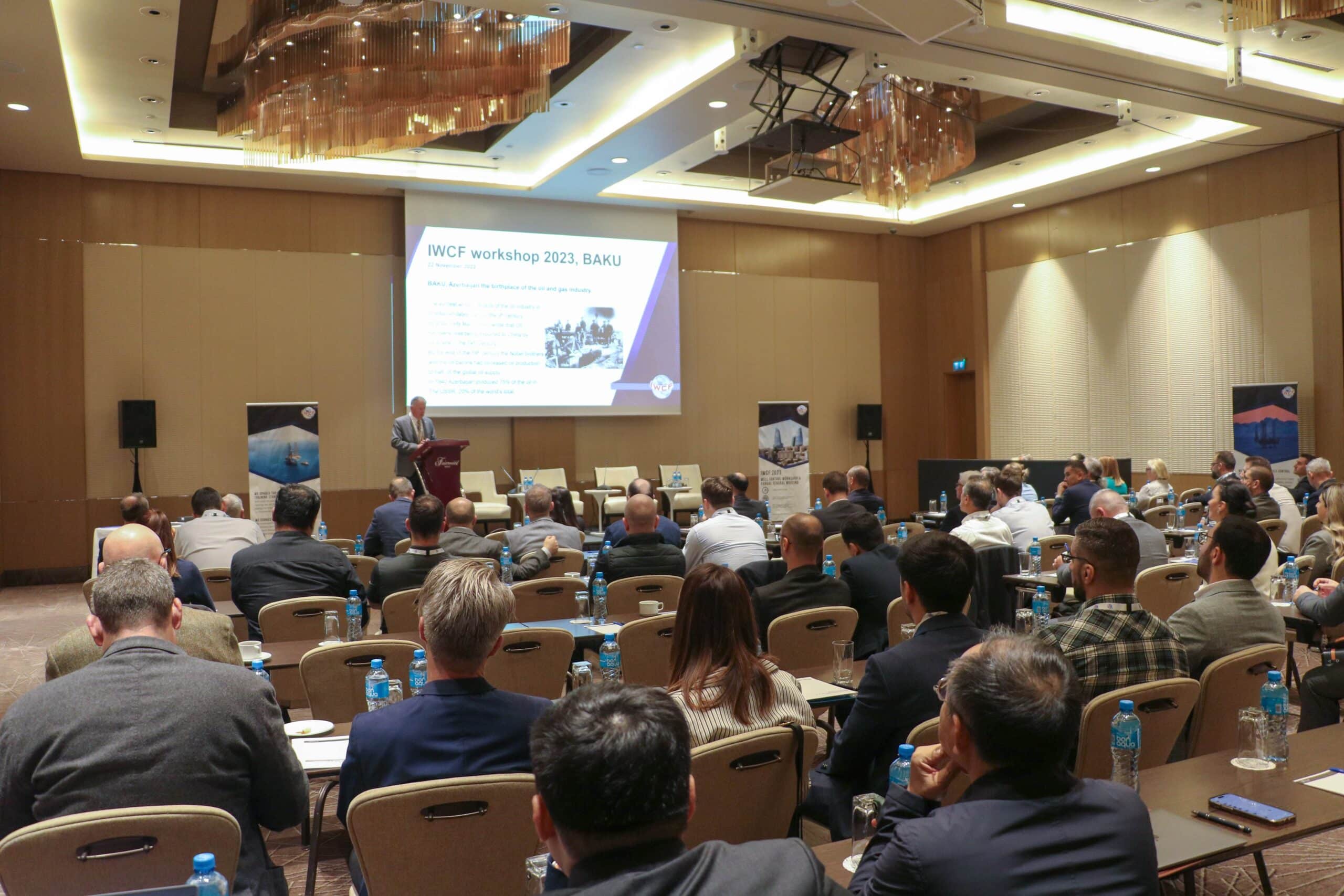
Mark your calendars! The International Well Control Forum (IWCF) has set the dates for its highly anticipated 2024 Well Control Workshop and Annual General Meeting, following the success of last year’s event in Baku, Azerbaijan.

Scheduled for 19 – 20 November 2024, at Hilton The Hague, Netherlands, this event promises to be another invaluable opportunity for industry professionals to connect, learn, and network.

Don’t miss out on this exciting opportunity to engage with experts and participate in interactive workshop sessions. Save the date and stay tuned for further updates as IWCF continues to provide information about the event.

IWCF encourages those interested to register to stay updated with timely information on what promises to be another incredible gathering of industry experts, interactive workshop sessions, and networking opportunities.

Your continued support and participation are essential to IWCF’s mission, and they look forward to welcoming you all later in the year.

Register your interest here!

Have questions? Contact IWCF at iwcfinformation@iwcf.org and stay connected with IWCF’s social media platforms for the latest updates!


International Well Control Forum (IWCF) Introduces Azerbaijani Language Option for Drilling Well Control Assessments

By News

International Well Control Forum (IWCF) recently launched a new Azerbaijani language option for the assessments in the Drilling Well Control Programme, Levels 2, 3, and 4.  

The addition of Azerbaijani translations marks a significant milestone for IWCF as it becomes the 18th language offered by IWCF for its Drilling Well Control programme. By offering assessments in multiple languages, IWCF aim to make training and assessments accessible to as many candidates as possible. As an organisation focused on oil and gas well control training, accreditation and certification, the inclusion of the new Azerbaijani translations aligns with IWCF’s mission to improve competency globally. 

The new Azerbaijani language launched on 1 August 2023 and candidates can visit IWCF’s website to find more information about the Drilling Well Control Programme. 

For more information and updates, follow IWCF’s social media platforms. 

Follow now and stay updated with their latest news! 


Well Control in Design and Lifecycle Management Programme Updates

By News

IWCF‘s Well Control in Design and Lifecycle Management programme is designed for engineers, supervisors and managers in key roles related to well construction, well interventions and well integrity. This programme aims to ensure that these personnel are equipped with the knowledge and skills needed to prevent well control incidents and manage wells effectively throughout the well lifecycle. 

While levels 1-4 of well control training do not focus on the crucial well design, planning and maintenance phases,  IWCF‘s Well Control in Design and Lifecycle Management programme offers an aspirational certification for these key roles.  

Aligned with our overarching goal to ensure no risk to life, assets or the natural environment, this innovative programme aims to enhance safety and reduce the number of well control incidents. 


What are the objectives of the programme? 

The programme aims to: 

  • Recognise the impact that design, planning and programming can have on the construction phase and on well integrity assurance throughout the lifecycle of the well.   
  • Identify and specify well control actions that can be taken when working outside of the normal operating envelope.  
  • Ensure that engineers in office-based functions have well control competence in support of rig/wellsite operations.  


What topics does it cover? 

The latest revision of IOGP report 476 included an update on topics that should be included in the programme. For a better overall learning experience, IWCF have separated those into compulsory and optional topics. Programme applicants can also choose from the list of optional topics and can propose alternative topics for consideration.  

Compulsory topics include: 

  • Subsurface impact 
  • Holistic design 
  • Design uncertainties  
  • Barrier management 
  • Cement integrity  
  • Verification methods 
  • Dealing with pressure influx 
  • Lifecycle well integrity 
  • Risk management 

Optional topics include: 

  • Human and organizational performance 
  • Corrosion design and material selection 
  • Well maintenance 
  • Well integrity assurance 
  • Shallow gas 
  • Abandonment 
  • Tertiary well control 
  • Other lifecycle considerations 
  • Well planning considerations 
  • Barrier integrity assurance 
  • Regulatory requirements.  


How can I attend this training? 

Accredited training providers can be found on our website map. Simply search for ‘Well Control in Design and Lifecycle’ in the programme filter.’ Please contact your chosen training centre for upcoming course schedules and costs.  


How can my training provider become accredited to offer this programme? 

IWCF have recently published a guidance document for the Well Control in Design and Lifecycle Management programme. This provides a comprehensive overview of the programme, including: 

  • Course structure 
  • Candidate requirements 
  • Instructor requirements 
  • Accreditation applications 
  • Case study project 
  • Assessment information. 

The Well Control in Design and Lifecycle Management programme guidance can be downloaded here 

Please contact accreditation@iwcf.org if you have any questions.  

International Well Control Forum (IWCF) IWCF Invites Members to Register for their Annual General Meeting and Workshop

By News

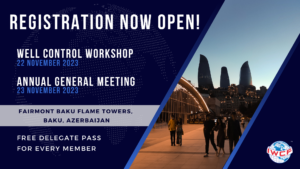
International Well Control Forum (IWCF) recently announced that its Annual General Meeting and Workshop will take place on November 22–23 2023 at the Fairmont Baku, Flame Towers in the vibrant city of Baku, Azerbaijan.  

The event will include a series of interactive panel sessions and presentations where global experts will share their knowledge and experience. 

Registration for the IWCF Annual General Meeting and Workshop is now open exclusively for IWCF members. If you would like to attend but aren’t currently an IWCF member, please contact membership@iwcf.org for more details. 

REGISTER HERE!

Attendees are also invited to join IWCF for an exclusive visit to the prestigious Nobel Museum on the afternoon of day one. 

With a guided walking tour, captivating presentation and refreshments, this event offers a perfect blend of knowledge, inspiration, and networking. Secure your spot now by responding to the “add-ons” section when registering to the Annual General Meeting and Workshop. 

Stay tuned to IWCF’s social media channels for more updates on this exciting event, and contact membership@iwcf.org if you have any questions. 

Don’t miss out on this opportunity to connect and learn with like-minded industry professionals.