
This edition of our blog series outlines how learning objectives, outcomes, and importance levels work together to create a clear and consistent framework for teaching and learning.
A well-structured syllabus is fundamental to any educational programme. It provides clear learning objectives and specific outcomes and ensures a level of standardisation between training institutions and teachers/instructors.
For well control training, having the correct skills and knowledge makes the difference between a controlled situation and a catastrophic blowout. This is why the syllabus is intentionally designed and structured to ensure all key topics are adequately taught and assessed.
What is a learning objective?
A learning objective is a clear, general statement that outlines the topic which will be taught and assessed. It sets the context for the more detailed and specific learning outcome.
What is a learning outcome?
Learning outcomes are detailed and make the results of learning clear, specific, and measurable. Action verbs such as ‘identify’, ‘explain’ or ‘describe’ signal to the instructor the scope the candidate must have to effectively meet the syllabus requirement.
Importance levels
The IWCF Drilling Well Control and the Well Intervention Pressure Control syllabi both apply importance level weightings to topics.
This framework highlights the most safety-critical principles, ensuring candidates build the core competencies needed to understand the full syllabus and develop the skills they will need in their roles.
Below is an example of the importance level structure from the WIPC syllabus.
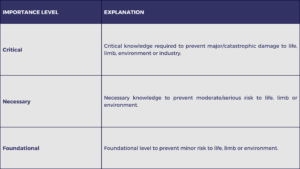
Syllabus categories marked with higher importance levels often contain principles that, while introduced within a specific section, are not confined to a single learning outcome.
These topics are critical for safe and effective operations that may appear throughout the entire well control syllabus, appearing in multiple contexts. Assessment questions often incorporate these principles when asking candidates to identify the safest or most appropriate first action in response to a well control scenario.
Examples of high-importance topics include managing barriers, leak detection, kick warning signs and indicators, secondary well control, and the management of non-shearables across the BOP.
IWCF has designed the syllabus in a way that all topics are necessary and must be both taught and assessed. While Level A outcomes represent the most safety-critical knowledge and skills, Levels B and C remain essential for supporting safe and effective operations.
Why this matters
Aligning learning objectives, outcomes, and importance levels gives both instructors and candidates a clear understanding of what’s expected and how each topic fits within the wider framework.
The IWCF syllabus framework ensures that every essential topic is taught and assessed consistently, supporting our goal of maintaining the highest standards of well control training worldwide.
If you have any questions about our syllabi for IWCF programmes, please contact us at assessmentdevelopment@iwcf.org.